
After PHP2Shell: we handed the site to AI
Two critical PHP vulnerabilities (PHP2Shell) exposed compatibility problems across framework, CMS and plugins; after migrating we rebuilt the whole site with AI, leaving only static files on the server.
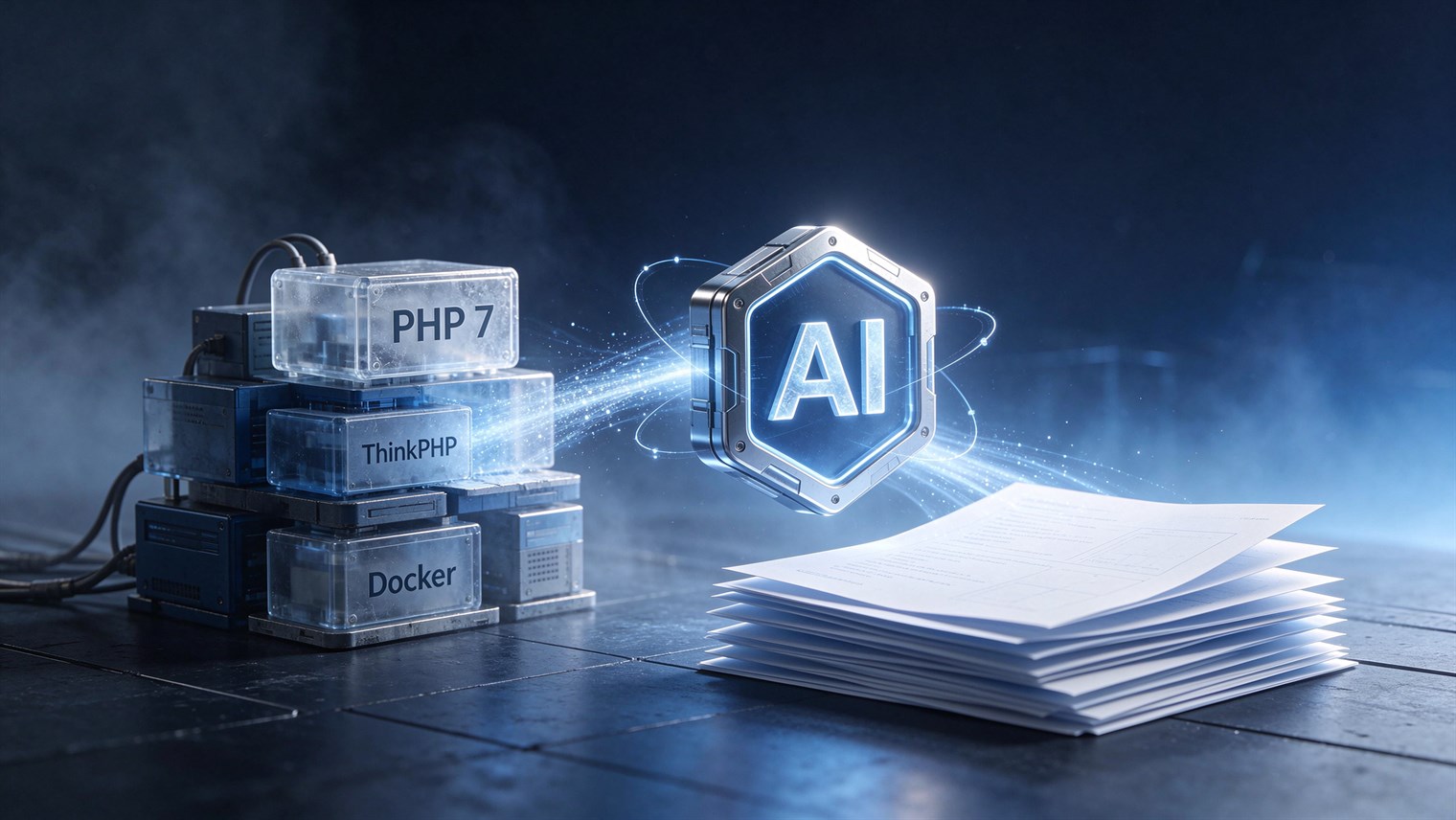
Two recent critical vulnerabilities, CVE-2026-109618 and CVE-2026-109619, are tracked together as PHP2Shell. Several of our older sites sat inside the affected range: PHP 7 + ThinkPHP, running in Docker on the server. The fix was not complicated — upgrade PHP, rebuild the Docker environment.
The hard part came after the upgrade.
Three layers of compatibility, each harder than the last
Layer one, the framework: would ThinkPHP run on PHP 8.3 at all? Layer two, the business code: once the framework moved, would the CMS still work? Layer three, the plugins: the extensions installed years ago to ship features — is anyone still maintaining them, do they still run?
The website side had never been busy — few clients, nobody watching it day to day. Only when we checked compatibility did we find that much of the old code could no longer explain its own origin; fixing one place broke another. Most of those days went into working out how it originally ran.
AI helped with the migration, and new problems surfaced
The migration itself was done with AI: read the old code, compare the diffs, propose changes, verify layer by layer. In the end the data was intact and the business never stopped — but it left a tail.
Some older articles would not open. The old CMS's templates, plugins and link rules were tangled together; fixing one broke another. At that point we accepted that this site could not be saved with patches.
So we rebuilt it: design to deployment, all with AI
That is how the idea of rebuilding the site with AI started. Not letting AI write a few snippets, but putting the whole job into an agent: design, page structure, prototypes, static pages, content templates, layer by layer. Deployment was authorised to the AI through an SSH key, and it ran on the server — uploading files, editing Nginx, issuing and configuring the HTTPS certificate, setting cron jobs, all from the command line.
Publishing later articles follows the same path: content written locally, the AI deploys incrementally, uploading only the files that changed.
Only static files are left on the server
The site's code and content both live locally now. Content is written as data files and pages are generated by scripts; what reaches the server is HTML, CSS, JS and images only. No database, no CMS, no server-side rendering. The contact form is the one exception, handled by a small separate service.
For security the change is direct: we used to defend PHP, the framework, CMS plugins and the database; now this layer is static files and a web server, with far less surface to attack. Failures roll back more easily too — the sources are local, so re-uploading is enough.
AI replaced more than the front end
A self-updating site used to mean code, a system, a database, and server-side rendering. Now the process is: describe the requirement to a local agent, generate the article, check it, let the AI deploy. Design, front end, database and CMS collapse into two actions — describe, confirm.
The source of this site is plain HTML, clearly structured, with tags where tags belong. After years of framework and build-tool output flattened into one line, reading this is a relief.
The PHP flaw was only the opening
Problems will not decrease in the AI era. This time it was PHP2Shell; next time it may be another language, framework or dependency. Vulnerabilities keep coming, and the practical way to limit the damage is plain: keep dynamic parts few, make what can be static static, shorten the publishing path, lower the cost of rollback.
We cannot predict where the next flaw appears, but we can make being affected equal to re-uploading a few files. For a site with few people maintaining it, that is worth more than anything.
Not much sentiment to add. AI made HTML shine again — looking at the flattened old code, then at this clean source, I will take that.